
Developer of the Hipodroomi Quarter: we’ll see if we are ahead of our time with our plans in Estonia
Reigo Randmets, CEO of Reterra, says they are building over 1000 apartments and a number of commercial buildings in the former Hippodrome. According to him, Estonian people are richer now than during the previous recessions. He advises investors to stay away from Spanish property.
We meet Randmets at the old Hippodrome, where construction has been underway since April last year and cables are currently being installed underground. The old, well-known Hippodrome building has been demolished and is now replaced by a modular building that imitates the kind of apartments that will soon be built in the residential area. We chat with Randmets in the modular house.
Reterra is building several new streets in the quarter, one of which will be a ring road and will run entirely underground. In the future, all cars will be underground in the Hipodroomi district, with only a few spaces for taxis, visitors and couriers. “The Wold and Bold spots, as we call them,” says Randmets. He points out that such real estate developments are currently fashionable in Scandinavia and elsewhere in Europe. “We’ll see if we’re ahead of our time in Estonia,” he says.
Around 30 percent of the apartments in the first phase of the Hipodroomi development are currently sold. The total land area of the whole development is over 250 000 square metres, of which the first phase accounts for just over a tenth.
Reigo Randmets, CEO of Reterra, in a show apartment of the Hipodroom development. Tairo Lutter
Randmets also says that there is a trend in real estate development where commercial and residential spaces are always together, and the Hipodroomi development is going along with it. This trend is driven by the aim to create a ’15-minute city’ to avoid commuting. “Another reason is that if you have a 100 per cent business district, the lights go out at five o’clock in the evening and it’s a zombie town until the morning – that doesn’t belong in a modern urban space,” he says.
Randmets recalls that the process of obtaining a building permit for the Hipodroom block was very long, taking six and a half years. The first phase of construction is currently underway and will be completed in early 2026.
Planning permission for the development was delayed because the developer of a small plot of land in the Hipodroomi district was taken to court over a prohibited donation to the Centre Party, which the party later had to repay. Mr Randmets stressed that the case had nothing to do with their company, but the incident delayed the granting of the building permit for them too. According to him, it was initially a matter of disagreement between the developers of the area and the city company Tallinna Vesi over who should make the big investment in the stormwater system. Read more about the Centre Party saga in the Postimees three years ago.
Popular periphery of Tartu
Reterra is also a major real estate developer in Raadi, close to the city of Tartu. “We set up shop in Raadi six years ago and we were the first ones there,” says Randmets. At first, he was hesitant to start building apartment buildings there because it seemed far from the city centre. But from the start of the sale, it became clear that customers were interested in the area and they took to it well. To date, Reterra has built around 500 apartments in Raadi and competitors have also started to develop properties in the area.
Asked by Postimees why people are interested in the area, Randmets said, “It is actually very close to the city centre. The street that goes towards the city quickly connects it to the city centre by car and by bike. It’s much closer to the city centre than it seems at first sight,” says Randmets.
Reterra also has a building in Erastvere, Põlva County. It was an old building that they renovated and now they rent it out to a nursing home. According to Randmets, the nursing home there seems to be doing well, even though he is not closely involved in their business. “The house is full of people and there’s a queue behind the door,” he says with a smile.
“As in other parts of the world, we in Reterra are also trying to maximise the preservation of old valuable buildings, or in other words, to use the existing resource. The Elevator is an example of this – the building has its own character and instead of demolishing it, we can give it a new life and use,” he says. The old grain elevator that Reterra will rebuild is located in the Nõmme district of Tallinn.
The market has experienced a revival recently
Randmets says that before this autumn, the real estate sector was quiet and now the market is showing signs of recovery. Ardi Roosimaa, member of the board of commercial real estate company Restate, told Postimees about a month ago the same.
“Of course we want to sell more apartments, but we can’t complain too much,” Randmets said. “You can’t say that there is a crisis at the moment,” he adds. But there has been a slight change in buyers’ behaviour. More people are taking more time to think about things and going through a lot of developments. Decisions take several months on average, but there are also those who think and consider for a year. “The days of walking in the door and buying immediately are over,” says Randmets. He also mentioned that there are more home buyers and fewer investors among the buyers than a few years ago.
The main buyers at the Hipodroomi are families or fans of the area, more than Randmets expected. According to him, the larger three- and four-room apartments are also selling well, showing that many people can afford to buy a decent home these days.
Speaking about the effects of the economic downturn, which has already lasted for several years, Randmets says companies have postponed moving into new commercial space. There is a lack of certainty as to whether it makes sense to invest in their business at this time. The trade and storage sector is still developing, but people are cautious about moving into new office space.
The residential property picture is brighter as the Estonian people have become wealthier than during previous crises. At the same time, the high euro interest rate is affecting all home buyers, he said. “There is nothing really wrong if you look at the bigger picture,” he says.
Latvia is behind the times
Reterra also owns real estate in Latvia. Asked by Postimees how the situation is in Latvia at the moment, Randmets says: “It’s difficult. It’s difficult. “Latvia is a bit behind the times.” “I used to think that Estonians felt that way, or that we wanted to think that way,” he says. Randmets explains that prices are still lower in Latvia and there have been no changes there comparable to the Estonian property market. “People there just have less money. At the same time, input prices are the same. In that sense, Latvia is definitely in a more difficult position than Estonia,” he says. But there is no more bureaucracy in Latvia than in Estonia.
Randmets says that talk of construction becoming cheaper during a recession is a myth because building materials will continue to rise in price. “Construction labour is one thing, inputs and materials are another,” he explains. He does concede that at some point, prices may indeed have fallen from their peaks, whereas now construction prices are consistently high.
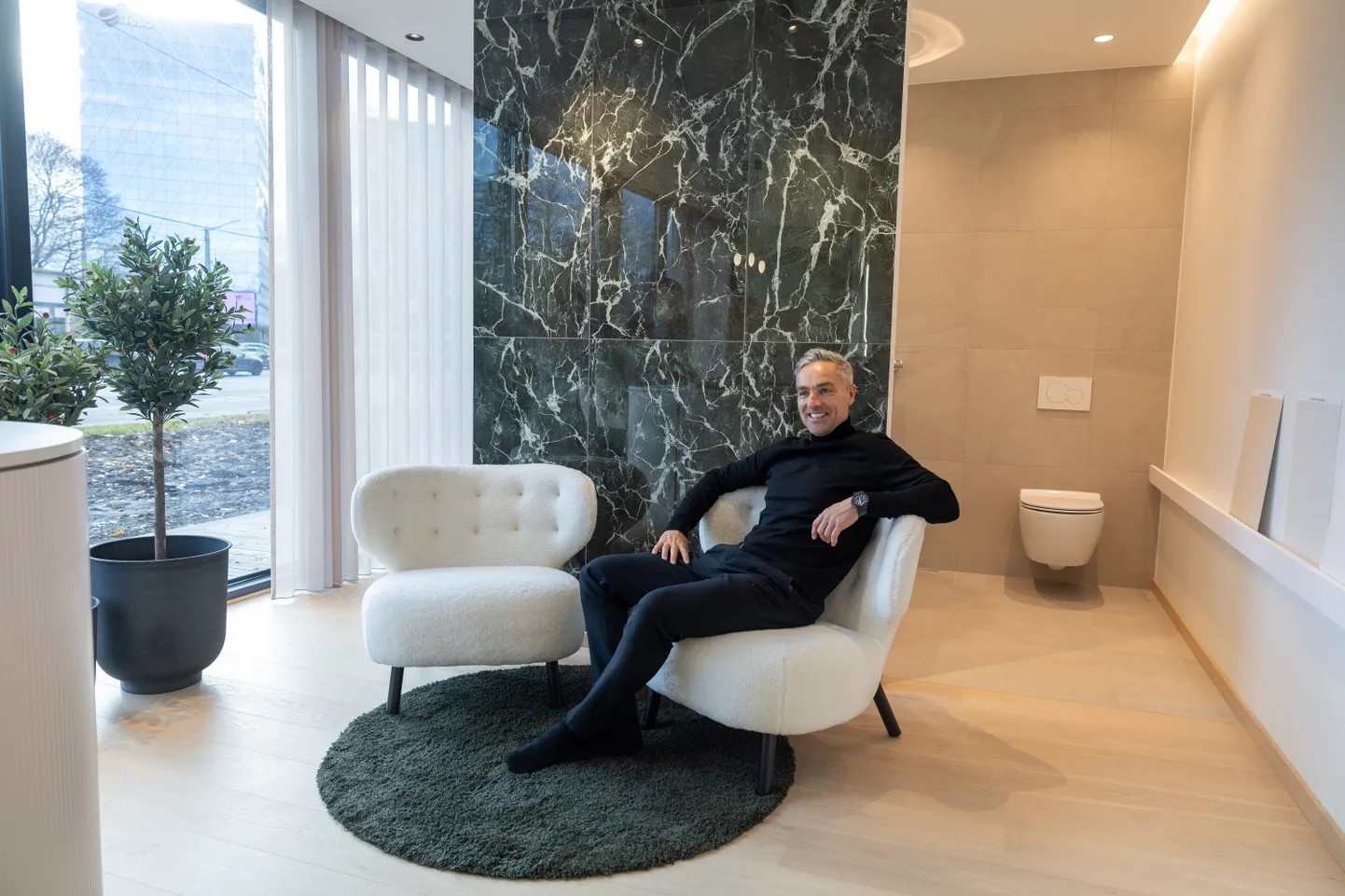
Reigo Randmets, CEO of Reterra, in a show apartment in the Hipodroomi modular building. Tairo Lutter
The Spanish property phenomenon remains incomprehensible
Postimees asked Randmets if he could explain why there have been rumours recently that Estonians are buying up property in Spain. He replies that he is not exactly sure, but gives two possible reasons. “Number one is that people are talking about it. For example, when a well-known Estonian band gives a concert abroad, we think they are world famous. It’s the same with this – if several people buy, it seems to us that all Estonians are there. I think it’s a bit exaggerated, and I think if you don’t want to go and live there yourself, it’s a big foolishness,” he says. He says that when buying property so far away, you need to have a trustworthy management company and be aware of local taxes, which can catch buyers by surprise.
“I certainly wouldn’t advise anyone to do this as an investment. If you want to move there and live there, that’s another matter,” he says.
Randmets says investors would be wiser to buy shares than to buy an apartment in an unfamiliar city with a business culture they are not familiar with.
Randmets says 2024 has gone according to plan for them. He believes that 2025 will see a new upturn in the real estate sector. While they have a lot of work to do on the Hipodroomi block, they also have many other developments in the pipeline. The hottest district in Tallinn right now is clearly Põhja-Tallinn, and Randmets also sees great development potential in Lasnamäe, where his company has not yet reached the construction stage, but where preparations are underway. He wants the city government to allow developers to build more density in the city centre.
“People need to be brought back to the city centre. Haabersti, for example, is clearly oversaturated with developments and there are more developments than demand,” says Randmets.
Reterra
The Reterra Group consists of Reterra Estate OÜ and its 38 subsidiaries operating in Estonia and Latvia.
Reigo Randmets owns a third of the company, the rest is owned by Mapri Ehitus OÜ, an Estonian company whose real beneficiaries according to the Business register are Margus Väärsi and Priit Jaagant.
The Reterra group’s revenue in 2023 was EUR 18.7 million and profit EUR 2.6 million.
The company develops residential and commercial real estate in Tallinn, as well as in Tartu, Riga, Peetri and Tabasalu. They have created the Woho Quarter, where Telia and Pipedrive have their headquarters.
The article was published on 7 November 2024 in the publication Postimees. By Aimur-Jaan Keskel.